Why Tracking Your Daily Expenses Actually Matters
You can't budget, save, or invest what you can't see. Here's the real case for tracking daily expenses — and why most people quit within a week of trying.
Every calculator on this site — SIP, FD, EMI, retirement — starts from the same unspoken assumption: that you know how much money you actually have left over each month to invest, save, or put toward a goal. Most people don’t, not precisely. They know their salary. They don’t know where it went.
The gap between salary and savings
Ask most working adults in India what they earn, and they’ll tell you instantly. Ask them what they spent on food delivery last month, or how much smaller subscriptions and cab rides added up to, and the answer is usually a shrug. That gap — between “I know what comes in” and “I have no idea where it goes” — is exactly where money quietly disappears every month.
This isn’t a willpower problem. It’s a visibility problem. You can’t fix a leak you can’t see.
💡 Aha moment
Every SIP or FD calculation on this site asks you for one input: how much can you set aside every month? Almost nobody answers that question accurately without having tracked their actual spending first — most people either wildly overestimate their surplus (and then can't keep up the SIP) or underestimate it (and leave money sitting idle that could have been growing). Tracking expenses isn't a separate habit from investing — it's the input investing depends on.
Why “I’ll just remember” doesn’t work
Most people’s first attempt at tracking expenses is mental — just try to remember what they spent. This fails almost immediately, for a simple reason: small, frequent expenses (chai, auto fares, a quick snack, a subscription renewal) are individually forgettable but collectively enormous. A ₹200 dinner sticks in memory. Twelve ₹40 chai runs across a month usually don’t — yet they add up to the same amount.
The second attempt is usually a notebook, or a habit of “I’ll enter it later.” Both run into the same wall: friction. If logging an expense takes more than a few seconds, or requires you to be sitting at a desk with a notebook, most people simply stop doing it within a week — not because they don’t care about their money, but because the process itself is annoying enough to skip.
Full disclosure
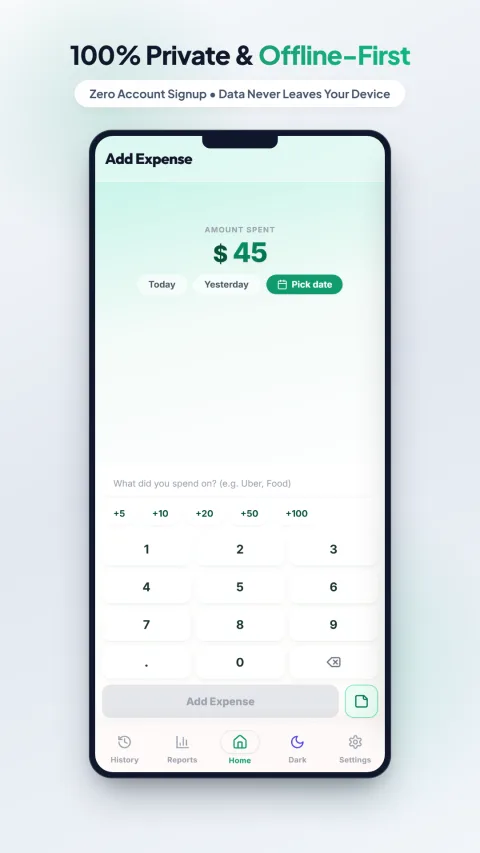
I built My Expenses Tracker to solve exactly this friction problem
100% private, fully offline, no account or signup — your data never leaves your phone.
What actually changes once you track expenses
Once even a month of real data exists, a few things become obvious that were invisible before:
1. You find your real “surplus.” Not the optimistic number you’d guess, the actual one — after rent, food, transport and the small recurring things you forgot about. That real number is what a SIP or RD calculator should actually be built around.
2. Spending patterns reveal themselves. Many people spend disproportionately more on certain days (weekends, paydays) or through certain channels (online shopping vs. cash). You can’t act on a pattern you’ve never seen.
3. “Small” expenses stop hiding. A ₹50-a-day habit is easy to dismiss in the moment and easy to miss entirely without tracking — but it’s ₹1,500 a month, and over a year, that’s money that could have gone into an SIP instead. Our SIP Calculator can show you exactly what that redirected amount could grow into over time.
4. You stop guessing during tax season or big purchases. Knowing your actual monthly spend makes it far easier to judge what you can realistically commit to a new EMI, a bigger Lumpsum investment, or a financial goal — instead of committing based on hope.
The habit is the hard part, not the math
Tracking expenses isn’t mathematically difficult — it’s a logging problem, not a calculation problem. The entire challenge is making the act of recording an expense fast and frictionless enough that you actually keep doing it past the first week. That’s the specific problem worth solving well, and it’s what the rest of this series digs into — from comparing notebooks vs. apps, to why most tracking apps ask for permissions they don’t need, to how to actually read the reports once you have the data.
Learn more from official sources
- Reserve Bank of India — Financial Literacy — RBI’s consumer financial literacy resources.
This is general information, not personalised financial advice. My Expenses Tracker is a free app built by the same person behind this website — disclosed here for transparency, not as a sponsored placement.